Paper:[2006.11316] SqueezeBERT: What can computer vision teach NLP about efficient neural networks?
Code:transformers/src/transformers/models/squeezebert at master · huggingface/transformers
核心思想:把全连接全部替换为卷积的 BERT。
背景动机
依然是对 BERT 系列模型架构的优化,出发点是提升运行速度。只不过本文是基于对图像领域技术的迁移,比如 grouped convolutions。具体来说,就是将 Self-Attention 的一些操作替换成卷积。最终达到比 BERT-base 快 4.3 倍的效果。
已有 CV 迁移 NLP 的技术
主要代表是 MobileBERT,使用了两个技术:
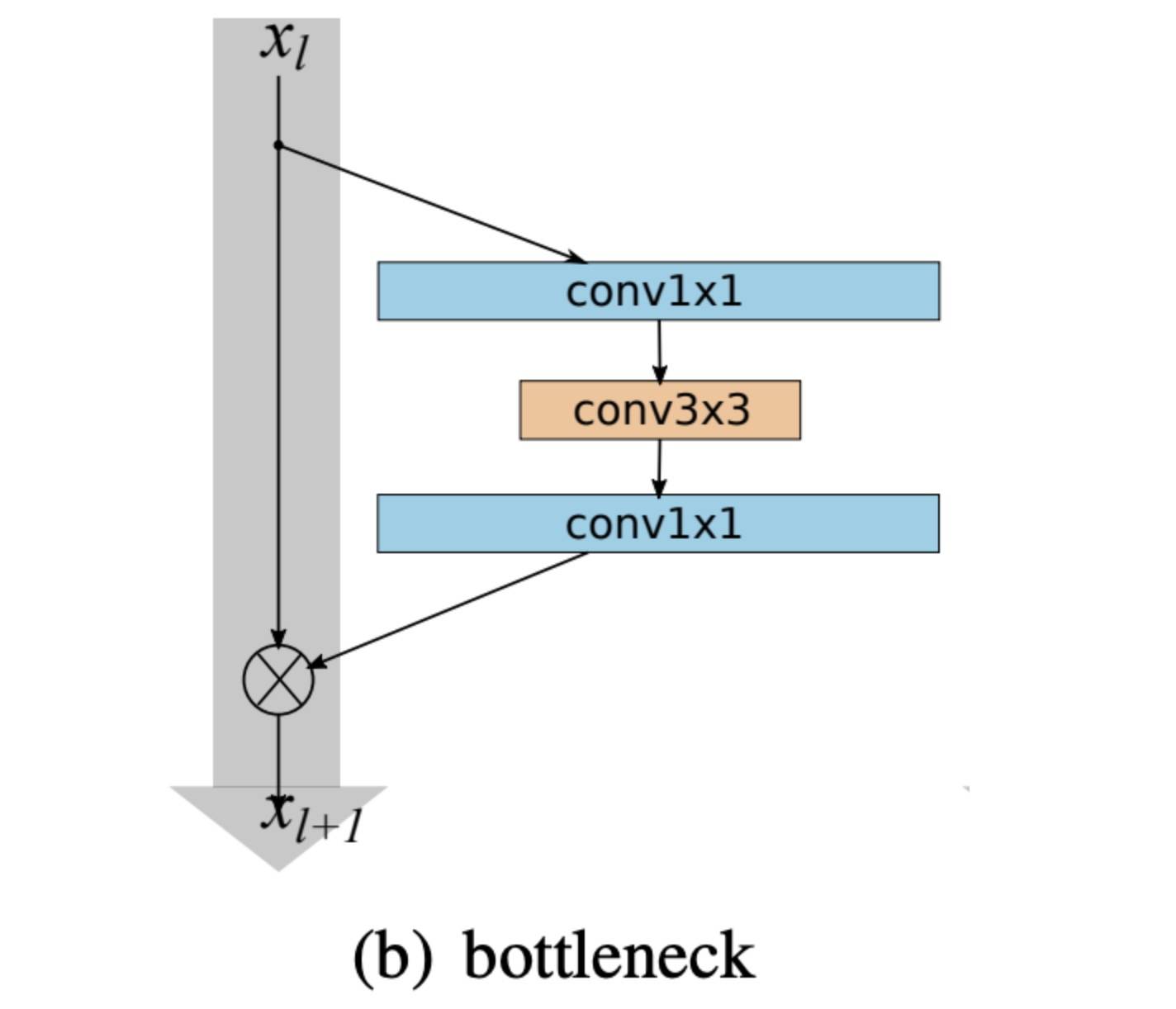
Bottleneck layers(见下图)
High-information flow residual connections,主要是针对 feed-forward layer,Self-Attention 本来就有。
图片来自:https://paperswithcode.com/method/bottleneck-residual-block
CV 还有哪些高效网络可以用到 NLP
Convolutions
Grouped convolutions
算法模型
Self-Attention + Convolutions
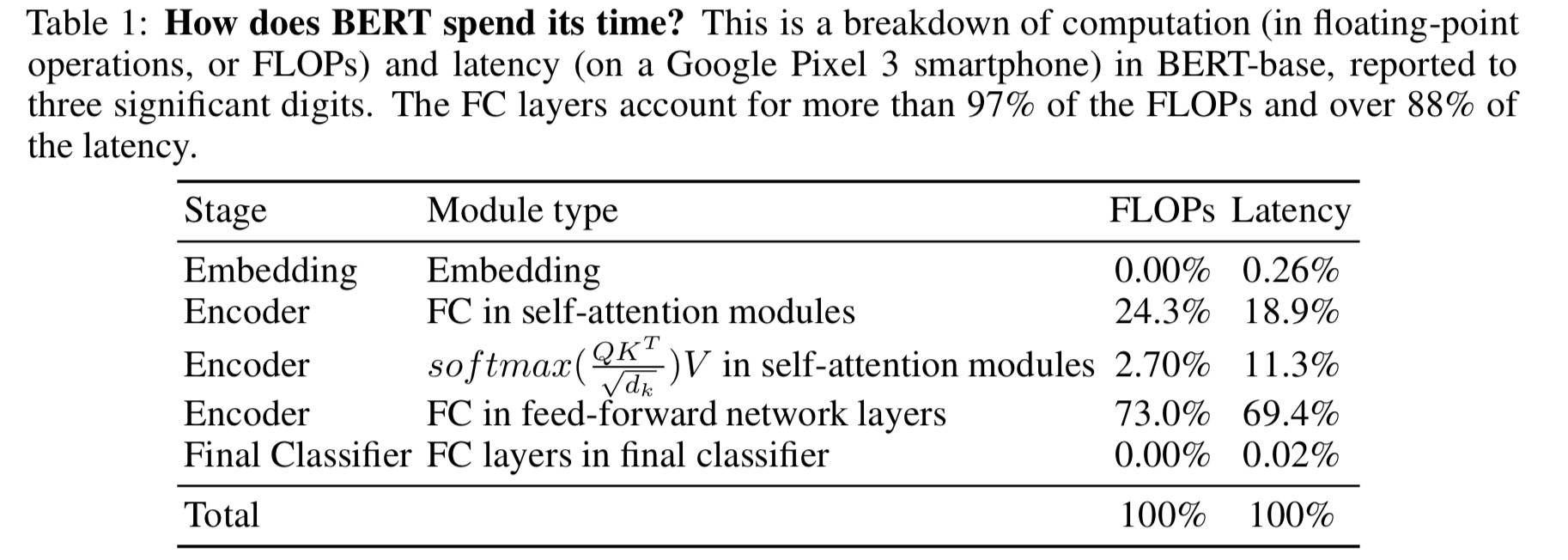
首先看一下 BERT 各个组件的耗时:
接下来就是要将 Encoder 中的 FC 替换为卷积。FC 如下:
PositionwiseFullyConnected p , c o u t ( f , w ) = ∑ i C i n w c o u t , i ∗ f p , i \text { PositionwiseFullyConnected }_{p, c_{o u t}}(f, w)=\sum_{i}^{C_{i n}} w_{c_{o u t}, i} * f_{p, i}
PositionwiseFullyConnected p , c o u t ( f , w ) = i ∑ C in w c o u t , i ∗ f p , i
p 是 position,也就是 sequence length,Cin 和 Cout 表示输入和输出的通道。用卷积替换:
Convolution p , c out ( f , w ) = ∑ i C in ∑ k K w c out , i , k ∗ f ( p − K − 1 2 + k ) , i \text { Convolution }_{p, c_{\text {out }}}(f, w)=\sum_{i}^{C_{\text {in }}} \sum_{k}^{K} w_{c_{\text {out }}, i, k} * f_{\left(p-\frac{K-1}{2}+k\right), i}
Convolution p , c out ( f , w ) = i ∑ C in k ∑ K w c out , i , k ∗ f ( p − 2 K − 1 + k ) , i
k=1 时,两者是等价的。代码更加直观:
1 2 3 4 5 6 7 8 9 10 11 class FC (nn.Module): def __init__ (self, cin, cout, groups, act ): super ().__init__() self .conv1d = nn.Conv1d( in_channels=cin, out_channels=cout, kernel_size=1 , groups=groups) self .act = ACT2FN[act] def forward (self, x ): output = self .conv1d(x) return self .act(output)
对应的原始版本是:
1 2 3 4 5 6 7 8 9 10 11 class BertIntermediate (nn.Module): def __init__ (self, config ): super ().__init__() self .dense = nn.Linear(config.hidden_size, config.intermediate_size) self .intermediate_act_fn = ACT2FN[config.hidden_act] def forward (self, hidden_states ): hidden_states = self .dense(hidden_states) hidden_states = self .intermediate_act_fn(hidden_states) return hidden_states
另外,针对 Self-Attention 和 Intermediate 之后的残差连接归一化层,其中的全连接部分也是用卷积替换:
1 2 3 4 5 6 7 8 9 10 11 12 13 14 15 16 17 class ConvDropoutLayerNorm (nn.Module): def __init__ (self, cin, cout, groups, dropout_prob ): super ().__init__() self .conv1d = nn.Conv1d( in_channels=cin, out_channels=cout, kernel_size=1 , groups=groups) self .layernorm = nn.LayerNorm(cout) self .dropout = nn.Dropout(dropout_prob) def forward (self, hidden_states, input_tensor ): x = self .conv1d(hidden_states) x = self .dropout(x) x = x + input_tensor x = x.permute(0 , 2 , 1 ) x = self .layernorm(x) x = x.permute(0 , 2 , 1 ) return x
这里注意 LN 的是 hidden size 维度。对应的 BERT 版本是:
1 2 3 4 5 6 7 8 9 10 11 12 13 class BertOutput (nn.Module): def __init__ (self, config ): super ().__init__() self .dense = nn.Linear(in_channels, out_channels) self .LayerNorm = nn.LayerNorm(config.hidden_size, eps=config.layer_norm_eps) self .dropout = nn.Dropout(config.hidden_dropout_prob) def forward (self, hidden_states, input_tensor ): hidden_states = self .dense(hidden_states) hidden_states = self .dropout(hidden_states) hidden_states = self .LayerNorm(hidden_states + input_tensor) return hidden_states
通过代码可以清楚地发现,唯一的改动就是将 Dense 变成 Conv1D。需要注意的是,Self-Attention 出来的 全连接层 group = 1,Intermediate 和 Intermediate 的全连接层 group = 4。
Self-Attention + Grouped Convolutions
接下来是对 Attention 中的全连接进行改造:
GroupedConvolution p , c o u t ( f , w ) = ∑ i C i n G ∑ k K w c o u t , i , k ∗ f ( p − K − 1 2 + k ) , ( i + ⌊ ( i ) ( G ) C o u t ⌋ C i n G ) \text { GroupedConvolution }_{p, c_{o u t}}(f, w)=\sum_{i}^{\frac{C_{i n}}{G}} \sum_{k}^{K} w_{c_{o u t}, i, k} * f_{\left(p-\frac{K-1}{2}+k\right),\left(i+\left\lfloor\frac{(i)(G)}{C_{o u t}}\right\rfloor \frac{C_{i n}}{G}\right)}
GroupedConvolution p , c o u t ( f , w ) = i ∑ G C in k ∑ K w c o u t , i , k ∗ f ( p − 2 K − 1 + k ) , ( i + ⌊ C o u t ( i ) ( G ) ⌋ G C in )
相当于把输入的向量切分成 G 个相互独立的卷积网络,FLOPs 变为 1/G,类似这样:
1 2 3 4 5 6 7 8 9 10 11 12 13 14 15 16 17 18 19 20 21 22 23 24 25 26 27 m = nn.Conv1d(768 , 64 , 3 , stride=1 , padding=0 , groups=2 ) input = torch.randn(4 , 768 , 512 )m(input ).shape, m.weight.shape class CnnTestModel (tf.keras.layers.Layer): def __init__ (self ): super ().__init__() self .n = tf.keras.layers.Conv1D( 64 , 3 , strides=1 , padding='valid' , groups=2 , activation='relu' ) @tf.function(experimental_compile=True ) def call (self, x ): out = self .n(x) print (self .n.weights[0 ].shape, self .n.weights[1 ].shape) return out ctm = CnnTestModel() x = tf.random.normal((4 , 512 , 768 )) out = ctm(x) out.shape
Tensorflow 的 groups 目前不支持 CPU,因此需要用 tf.function 的 experimental。输出两次是因为第一遍是构件图时输出的,第二遍是执行计算时输出的。更多关于 Group Conv 可以参考这篇 论文。
具体在 Self-Attention 中是这样的:
1 2 3 4 5 6 7 8 9 10 11 class SqueezeBertSelfAttention (nn.Module): def __init__ (self, config, cin, q_groups, k_groups, v_groups ): super ().__init__() self .query = nn.Conv1d( in_channels=cin, out_channels=cin, kernel_size=1 , groups=q_groups) self .key = nn.Conv1d( in_channels=cin, out_channels=cin, kernel_size=1 , groups=k_groups) self .value = nn.Conv1d in_channels=cin, out_channels=cin, kernel_size=1 , groups=v_groups) ...
groups 的参数在 config 中都是 4。
实际效果
数据说明
Pretraining: Wikipedia + BooksCorpus, 3% test, MLM + SOP
Finetuning: GLUE
训练方法
从头训练:
预训练:LAMB optimizer,batch_size 8192,learning_rate 2.5e-3,warmup proportion 0.28,56k sequence length 128, 6k 512
微调阶段:AdamW without momentum or weight decay with β1 = 0.9 and β2 = 0.999,batch_size 16
蒸馏:
只在微调阶段,蒸馏最后一层
预训练后在 MNLI 上微调,然后再到其他任务
实验报告
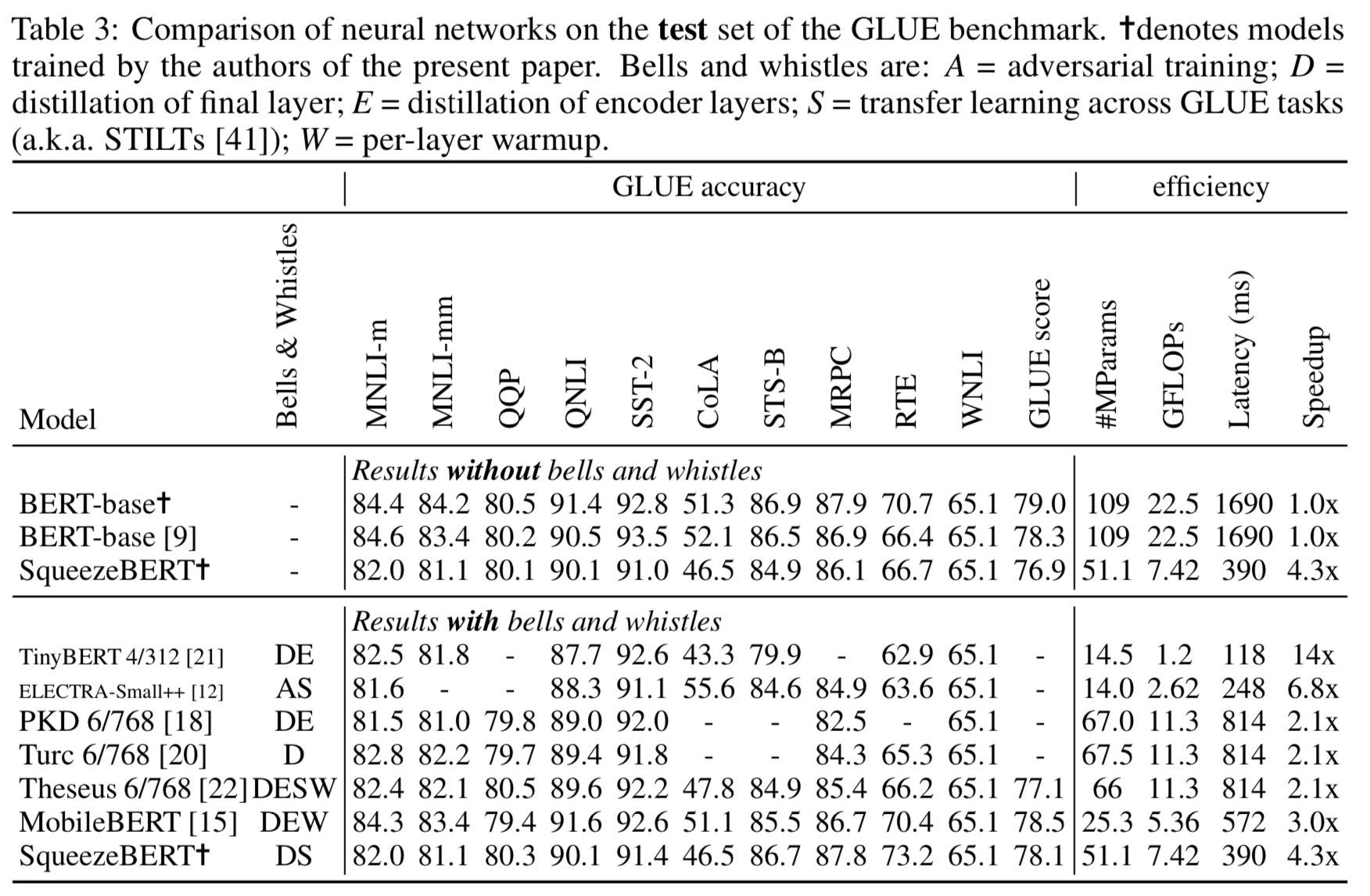
代表性看一下 test set 的结果:
综合这个结果看,我认为 TinyBERT 不错:D
相关讨论
NLG 任务中的应用:
Evolved Transformer 和 Lite Transformer 在网络的不同部分中包含 Self-Attention 和卷积。
LightConv 表明精心设计的卷积网络(没有 Self-Attention)和 Self-Attention 网络在部分 NLG 任务上取得相当的结果。
从 CV 到 NLP 还有什么:
下采样策略:随着层不断往前,减少 Self-Attention 中激活的序列长度。
U-Nets(U-net: Convolutional networks for biomedical image segmentation)